Saturday, November 19, 2011

Jaipur – The Pink City


Just one of the stranger occurences - open urinals
 right on the main drags in towns
We drove from Agra to Jaipur, a fairly boring ride, but on the way, our driver, Rampal, was always on the lookout for photo opportunities for Frank: camels, elephants, monkeys, a bus with as many people sitting on the top of the bus as were inside it, and other unusual things that you don’t see here in America. 
The groom and two of his buddies trot down the center
 of a busy highway on the way to his wedding
Jaipur is another large city with lots of traffic and the usual mayhem.  But we did see an odd sight:  three men riding white horses decorated with the most ornate and colorful saddles – riding right in the middle of all the city traffic.  Rampal explained that they were headed for a wedding.  Apparently in India, the groom makes quite a splash by riding to the ceremony on a fancy white horse!
The following day, our Jaipur guide, Amid, gave us the full sightseeing tour.  It is easy to see why Jaipur is called The Pink City – everything within the old city walls is pink.  Most of the pink color comes from the local building material, reddish pink sandstone, but even storefronts and metal garage doors are painted pink.
The Palace of the WInd
First stop was the Hawa Mahal, aka the Palace of the Wind, a graceful 5-story structure with 152 windows.  The sole purpose of this building was so that the royal ladies could observe the action on the main street from behind stone “screens” without being seen.   The building looks like a giant peacock with a rippled roofline and protruding balconies that look like “feathers.”  Once again, the peacock, the national bird of India, integrates itself into the action.

Frank and Anne head for the Amber Fort on "Bowwan," the elephant

On to the Amber Fort, a terrific site up on a mountain overlooking the modern city where we made a grand entrance on a gentle elephant named “Bowwan.”  Of course, the elephant ride was ridiculously touristy, but too much fun to resist.  Up to the top of the mountain we rode, nauseously rocking with every ungainly step that Bowwan strode. 
Anne checks out the Winter Bedroom
Inside, the fort/palace, a beautiful courtyard led to one of the prettiest rooms we have ever seen, the Maharajah’s Winter Bedroom.  Every inch of the inner room and the pillared pavilion surrounding it was covered with convex mirrors and small polished silver devices – a sparkling sight.  Amid explained that the floors would have been covered with colorful carpets and that lamps in the wall niches would cast reflections around the room, resulting in a dazzling effect like a kaleidoscope.  On the practical side, the mirrors were supposed to reflect the heat of the lamps to keep the Maharajah warm during the cold season.    
We also saw the “wheel chair” used by the Maharani at festival time.  Apparently, her best gowns were so heavy with gold thread and semi-precious stones that she couldn’t even walk under their weight, so she had to be pushed along specially built ramps in her rolling chair.   Another part of the palace was specifically designed by a Maharajah who had 12 wives.  His large courtyard held 12 identical apartments to house each of the women and included hidden passageways allowing him to secretly visit any wife of his choosing without the other women getting jealous.  What a guy!
Shopping in the handicrafts store
We made the inevitable stop at a handicrafts shop, but actually had a good time.  Shopping here in India is quite an experience.  They have shelves and shelves of all kinds of textiles.  If you show the slightest interest, things start flying off the shelves:  scarves, tablecloths, bedspreads.  One after another is spread dramatically before you, usually flipped up into the air so that it floats back to the counter.  “We have many colors.  If you like one, why not two or four or six?”  These guys are remarkably tenacious.  Frank bargained hard, so at least we didn’t feel as ripped off as usual.  Unlike the Chinese who love to haggle and make it a game, many of the Indians act peeved when they give in to our price -- which only means they are mad because they couldn’t get the usual 5 or 10 times the true price!
Frank standing in front of the world's largest sundial
Our last stop of the day was at an astronomical observatory called Jantar Mantar with an open air assortment of astronomical instruments including the world’s largest sundial.  Frank was fascinated by the scientific instruments, but disappointed that so many of the instruments were related to astrology.  Astrology plays a major part in arranged marriages in India, so plotting horoscopes correctly was a big deal.  (Today it is done via computers.)
The bizarre Nehru Bazaar
The following day was a “freebie day” (i.e., no tour guide) so we chose to devote it to shopping and massage.  Unlike the typical tourists, we wanted to visit the bizarre bazaars.  Our driver Rampal seemed quite hesitant about taking us but eventually dropped us off at the somewhat daunting Nehru Bazaar, with an expression on his face like he might never see us again.  The bazaar was rough and dirty, and we were the only white faces around, but everyone was friendly, and we had a blast.
Anne had scoped out a recommended Thai massage place called Ziva Spa.  The masseuses were all Indians (Thai-trained, the manager assured us) but the place was spotless with all the amenities: soft lighting, soothing music, and nice “pajamas” to wear.  Neither one of us could believe it when our hour of massage was over.  What a nice respite from the craziness outside.
Women sell gold marigolds everywhere for "good luck."
Let’s take a minute to talk about what we have been drinking.  (India can definitely drive you to drink LOL!)  Frank’s favorite beverage is Kingfisher, the only beer we’ve seen here in India.  He especially likes the hard-to-find “Kingfisher Strong” variety, which sports an 8% alcohol level kick.  But India also offers a wonderful assortment of fruit juices including mango, papaya and guava.  Iced tea and real lemonade are also good, but Anne’s favorite cold drink is something called a “lassi,” a liquid yogurt drink available in many flavors like coconut and banana -- very refreshing and good for digestion too.  Another favorite of Anne’s is Masala Chai, a hot tea made from spices like cinnamon and cardamom mixed with milk and sugar – like an adult version of hot chocolate.
The Indian Swastika -- symbol of eternity
The swastika symbol is a frequent sight here in India.  You’ll see it in architectural design, in paintings, and they are even painted all over trucks and tuk-tuks that you see riding down the road.  Of course, the swastika is a design used in the past by many cultures, and if you ask the Indians about it, they assure you that it is not the same swastika used during WWII, but a reverse twist on Hitler’s infamous emblem.  In Indian culture, this reverse swastika has always meant infinity or eternity.
More faces of India:
Cobra charmer at the Amber Fort


Wednesday, November 16, 2011

Agra – Home of the Most Beautiful Building in the World

Waiting for the train
We caught a late afternoon express train for Agra.  This train experience was much better than our overnight trip but still pretty rough around the edges.  Unbelievably, they kept plying us with food during the relatively short trip (2 ½ hours): snacks, sandwiches, hot tea etc.  Most of which we didn’t eat – if you think U.S. train/plane food is bad, wow!! You are in for a real treat here.....
Train stations in India are real horror shows, with overcrowded platforms of travelers, beggars, and people lying around sleeping on the concrete floors (or are they dead?).  Luckily, we had a handler to make sure we got on the right train in all this mess.  We consider ourselves “train experts” in any other part of the world but wouldn’t attempt it on our own here.  We actually met a couple from Idaho at the train station named Bill and Bobbie, who also had a handler to get them oriented.  It’s always fun to commiserate with fellow Americans about the trials and tribulations of traveling in India (although we would have to say that we seem to be handling it much better than most).
The incredible Taj!
We arrived about 8:30 p.m. in the city of Agra – after dark and too late to see anything, although we did get a distant first glimpse of the Taj Mahal from our hotel balcony.  Yes, this is the city where the grandest building in the world resides (in our humble opinion).  Our hotel room looked terrific, but as always in India, things are not what they appear to be.  The seemingly modern shower with its touchpad controls looked like a dream until we stepped in and realized that the water temperature fluctuated wildly on its own from scalding to lukewarm, and the water was a disgusting yellow/green color.  Such are the realities of travel here.
Monika shows us the gorgeous inlays of
the Taj Mahal

The next morning, we were totally psyched to visit the world famous Taj Mahal with our new Agra guide, Monika Sharma -- she was our first female guide here in India, and by far our best guide yet.  Monika was everything we like in a guide: knowledgeable, smart, curious, enthusiastic, energetic, and just so much fun.  She showed us the sights, but also taught Frank lots of helpful Hindi words, and told Anne all about Hindu weddings (which tend to last for 15 days).  What a wealth of information she provided.   We wanted to pack her up and bring her home with us!
The Taj Mahal is simply the most beautiful building we have ever seen.  We wondered how it could possibly live up to the hype, but the Taj was better than we ever dreamed.  We arrived about 8:30 a.m. when the lighting was ideal, and it wasn’t overly crowded.  It is impossible to describe the glimmering white marble and the wondrous reflection in the mirror pool in front of the building.  You have all seen the pictures, but they do not begin to capture the grace and elegance of this place when you see it in person.
Up close, the Taj was a revelation with the most beautiful floral designs created with inlays of precious and semi-precious stones.  The marble itself sparkles from the crystals embedded in it, and the semi-precious stones glittered in the sun like so many diamonds.  The Taj Mahal was created by Shah Jehan as a memorial mausoleum to his favorite wife, Mumtaz, who had died giving birth to their 14th child.  The couple is buried side by side in the basement, but replicas of their caskets are on display in the rotunda located in the center of the memorial at ground level.  This room has a sacred feeling to it much like a cathedral.  One of the many things that make the Taj so pleasing is the perfect symmetry of every aspect of the complex.  Only one thing lacks symmetry:  Shah Jehan’s tomb is not quite identical to Mumtaz’s tomb – it’s bigger!
Reflection pool showing the symetry of the Taj
Oddly enough, the Taj Mahal is built over a large well, an engineering design which helps makes this beautiful palace earthquake resistant.  If an earthquake occurs, the Taj foundation will “float” on the waters of the well, and the destructive shaking forces transferred to the structure are minimized by the damping action of the water. This also means that the river immediately behind it is an advantage and actually part of the anti-earthquake design, since it keeps the well beneath the structure always automatically filled with fluid, protecting the Taj for eternity – or until the river runs dry.  The details of the unusual foundation were discovered by the British when they tried to move the Taj.  Yes, the Brits in a fit of arrogance during their tenure here, tried to uproot the Taj and move it back to merry old England!  Anyway, happily for all, their plans failed, and the Taj remains just where it was always meant to be.

At the "Baby Taj"


Agra has two other places of interest as well: the “Baby Taj” and the Agra Fort.  The “Baby Taj” is older than the Taj and was probably the inspiration for it.  As its name implies, it is a mausoleum similar to the Taj, but on a smaller scale.  Both buildings were created by Persian workers and many of the walls and ceilings look like Persian carpets, only they were formed with marble and semi-precious stones instead of cloth.  Designed by a woman (Mumtaz’s aunt), this building has a delicacy that feels very feminine.  The marble inlay is gorgeous here as well, especially the Tiger’s Eye stones.


Red sandstone walls of the  Agra Fort

The Agra Fort is a huge place made of red sandstone that is part palace and part military installation.  Shah Jehan, the builder of the Taj, was imprisoned here by his 3rd son (after a “little misunderstanding” over the issue of succession to the throne) for 8 years before Jehan died.  Shah Jehan could gaze at his beloved Taj Mahal across the river, but he never entered it again during his lifetime.  However, don’t feel too sorry for Shah Jehan -- his prison was a fabulous suite of rooms with plenty of inlaid gems, an intricately carved fountain, and a wonderful pillared balcony.  Also, his seeming altruism and bereavement in building the Taj for his lovely wife Mumtaz nearly bankrupted the kingdom, and he probably deserved  imprisonment for his blind waste of treasury coffers.  Another interesting fact: beneath this fort lies a network of tunnels that are said to lead all the way to Delhi!
 As we were walking around taking in the sights, we heard a voice call out, “There’s Frank and Anne!”  We were momentarily stunned -- nobody knows us here.  Turns out, it was the couple from Idaho who we had met in the train station.  Quite a coincidence to bump into two familiar faces in these crowds of tourists!
Thirsty Monkey at the Agra Fort!
That night we ate dinner on the hotel’s rooftop terrace.  We noticed a rifle hanging on the side of the building (which was a bit alarming).  Suddenly, while everyone was eating at the terrace tables, a big old monkey jumped down from one of the trees and scared the living scheiss out of all; a hotel waiter grabbed the rifle and shot the monkey!  Actually, he only scared him away, but we were pretty impressed that the hotel staff goes to extreme lengths to keep its patrons safe!  You never know what’s going to happen next around here.
We left Agra after just two nights, but Monika came with us to a nearby place called “Fathepur Sikri.”  Our ace guide Monika was her usually chatty self, telling us all about her brother who recently had a “love marriage” (instead of an arranged marriage that is still very common here in India).   Monika told us that if she cannot find the right guy for herself for a marriage, she will let her parents arrange a marriage for her because, as she said, “then they will be responsible for the choice, not me!”
The 5-story pyramidal-shaped entertainment complex
 at Fathepur Sikri
Fathepur Sikri is an ancient fortified city built by the famous Mogul ruler named Akbar.  Akbar was a pretty bright and open-minded guy – he was a big fan of religious tolerance and proved the point by marrying three women: a Muslim, a Hindu, and a Christian.  Each wife had her own designated area in the palace, and the architecture of each area was a mix of these 3 religions.  The Hindu wife even had her own Hindu Temple, and a kitchen that never saw a piece of meat.
Anne checks our Akbar's giant stone platform bed
Akbar had a lot of toys: a gigantic stone platform bed that required an 8 foot ladder to reach (and a lot of cushions to make it comfortable!).  He created a life-size game board (similar to chess) in the stone floor of the open courtyard – and reputedly using his harem girls as game pieces!  Akbar also had a favorite “execution elephant” who crushed those found guilty of serious crimes.  The condemned person’s only hope of a pardon was to appeal directly to the elephant – Akbar trusted the elephant’s judgment, and if his elephant hesitated to crush a person, they were free to go.

Anne and tour guide Monika examine the beautiful art work 

Saturday, November 12, 2011

Orchha – Land of the Maharajahs

Dedicated to Harold Gross (01/21/1927 - 11/05/2011) 

Water buffalos rule the roads
Another thing about India:  no one likes to give you bad news (so they lie a lot, or leave out main parts of the story).  We were told that the drive from our town of Khajuraho to Orchha would be about 4 hours, but in actuality, the ride took 7 grueling hours (with two stops).  The distance was only 180 km (about 115 miles), but the roads were the worst we have seen yet.  For most of the way, we drove on a single lane road that both directions of traffic had to share.  When 2 cars were coming at each other, one or both often had to give way by pulling over to the ditch side of the road. 
Overloaded tuk-tuk with people hanging on the back
Tuk-tuks, cars, people, and every conceivable bicycle contraption was attempting to use the road surface, often so pockmarked and potholed that it was almost undriveable.  For those of you who ski, the road was the equivalent of a ski trail full of moguls!  Every once in a while, we hit a relatively smooth stretch of macadam, but for the most part we bumped along at 10 miles an hour, dodging every obstacle on the road (including cows, goats and water buffalo), veering around treacherous road craters, and playing a constant game of chicken with oncoming traffic as every vehicle vied for the “best” section of roadway.
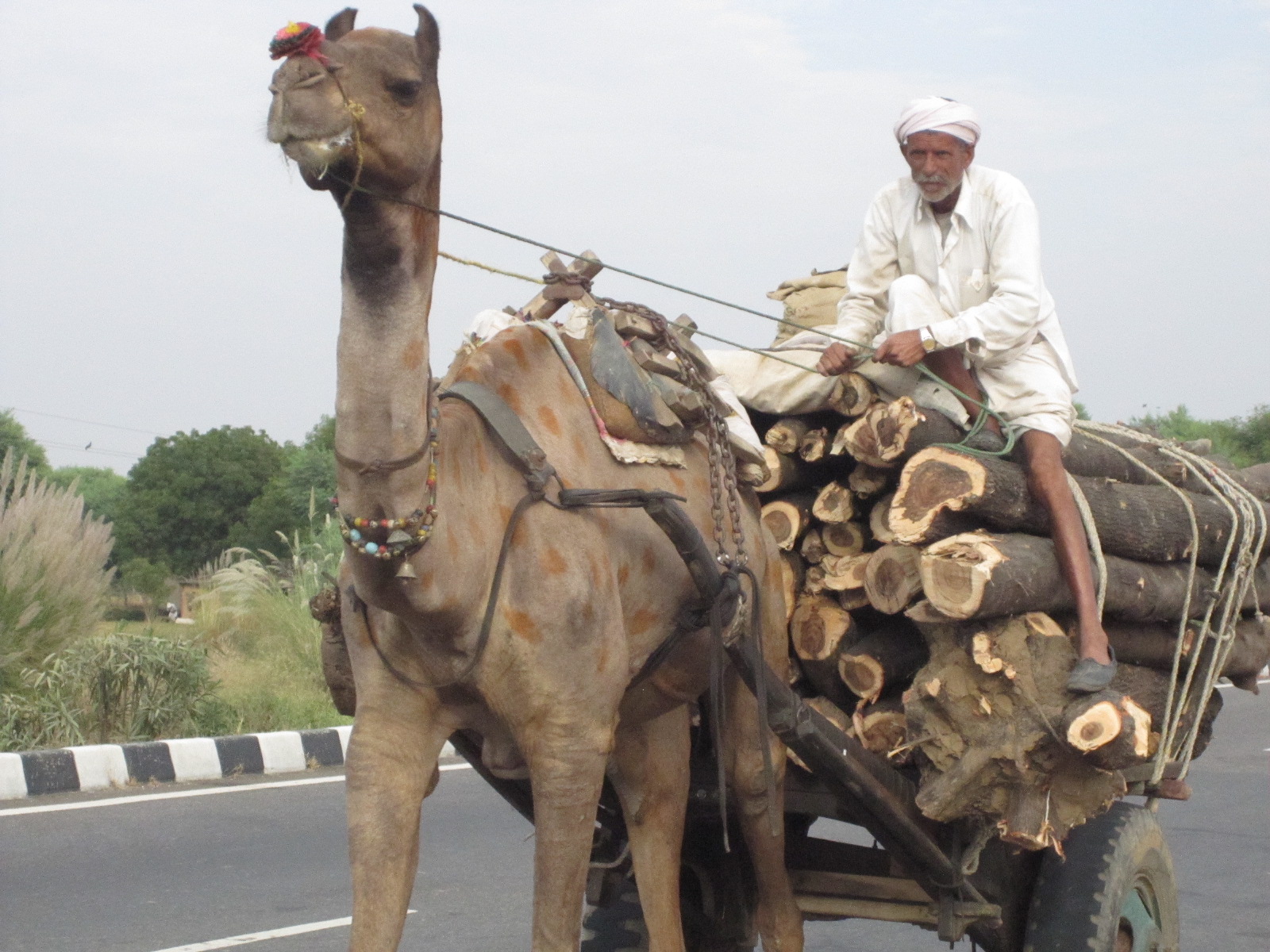
Camels are part of the workforce here in India
The situation would be confounding to all but the most intrepid; one broken car axle or tie rod would leave us stranded for days.  Needless to say, it was a long, bumpy, dusty day, but the sights along the way kept us fully entertained.  Never a dull moment with cows and goats all over the roads, tuk-tuks filled to overflowing (the legal limit is 4 people but we saw overloaded tuk-tuks with a dozen or more passengers including young guys hanging on the back and sides), delivery trucks painted with the most colorful designs (almost like circus cars), motorcycles carrying as many as 4 passengers at a time, and buses of Diwali revelers blaring the loudest and strangest sing-songy horns we ever heard.  And that was just the activity ON the road.  Our journey took us through tiny villages and larger towns all teeming with people wandering around the markets, getting haircuts on stools in dusty parking lots, good old village boys drinking at the local café, etc.  We even saw our first elephant – “parked” in front of a school.  We never get tired of all this fascinating action that you’d never see back home.  
Local milkman makes deliveries of water buffalo milk
We made two stops along the way: one stop to stretch our legs at a so-so museum of Hindu statues and a second stop to eat lunch.  Both the museum and the restaurant were located in palaces formerly owned by Maharajahs.  These Maharajahs lived like kings, reigning over large tracts of land out here in the countryside.  The architecture of these palaces is wonderful with lots of arches, fancy balconies, and minaret-like turrets.  On the surrounding hillsides, we could see the ruins of forts and hunting lodges that were once part of one Maharajah’s huge estate.  Descendants of the Maharajah still own (and sometimes live in) these palaces often operating them as hotels.  But they have no real power anymore and no political influence (unless elected to a specific political post).
The Bundelkhand Riverside Resort where we stayed
We arrived in Orchha (at last!) and rolled down a long unpaved lane to the Bundelkhand Riverside Resort Hotel located along the scenic and sacred Betwa River -- a refreshingly tranquil walled estate with gardens and colorful flowers everywhere.  In keeping with the Maharajah theme of this part of the trip, our hotel was once owned by another Maharajah.  We have a huge room, actually a bedroom and sitting room, all furnished with antiques.  The bathroom has more than a few quirks, but the ambience is well worth some minor inconvenience.
Maharajah Palaces of Orchha

Sunset over the chattries
 (cremation sites of the Maharajahs)

The highlight of our time here was our tour of the palaces of Orchha with our latest guide, Hemant Singh.  Hemant gave us a fun tour, and playfully called us Maharajah and Maharani.  But all kidding aside, these Maharajahs and Maharanis sure knew how to enjoy a rich regal lifestyle on the backs of the people.  They were king and queen on a small regional scale.  When the royal pair would make a grand entrance into their palace, servants would lean out of an opening high above the main arch to drop flower petals over their heads.  Then, the Maharani would spend her day being gently pushed on a swing while the Maharajah went out hunting tigers.  The palaces are a fascinating mix of Islamic and Hindu architecture because during this time period, the two religions coexisted quite comfortably.   
Frank leads the local kids in a rousing rendition
of "The ABC Song!"
Anne gets her palm and arm "tattooed" Hindu style!
The following day, Hemant took us to a small government village where the homes and the public school have been provided by the government in an attempt to improve the lot of the poor rural people.  We visited a school here, and got a warm welcome from the friendly young students.  We also got a really close-up look at village life: cow patties drying in the sun (used as fuel for cooking), and we even got to watch a guy hosing down his water buffalo!  Later, we took a stroll through Orchha’s market for some good souvenir shopping.  Anne even got her palm and arm stamped with various designs (hopefully, the vendor was telling the truth when he said it would wash off!)
Villager hoses down his happy water buffalo
One of the many things we find hard to understand here is customer service.  In general, the hotel staff mean well (or maybe just mean to get a good tip), but they can really drive us crazy.  We know that we are constantly being observed, and lots of times, they follow us around (or as Frank often says, “they track us like a bad fart!”). 
Cow dung patties drying in the sun (used as fuel for cooking)
Sometimes, with our guides, it is hard to pin down details like the daily schedule (which keeps changing).  They can even be a bit dishonest or vague, or language-challenged at a convenient time.  For example, the day we were scheduled to visit the small village, our guide Hemant arrived late and announced, “We have problem.  No car for you today.”  This was “interesting” since we had discussed this just the day before, and our itinerary clearly stated that we had a car at our disposal today.  So, we pulled out our master schedule (the revered “programme”) to show Hemant.  He made a few calls and guess what?  “Car is coming!”
"The Saylorsburg Slugger" knocks one out of the courtyard!
While we were waiting for that car, talk of a game of cricket began circulating.  Frank had never played cricket before, but a cricket bat and ball suddenly materialized and Hemant invited Frank out into the quadrangle for some cricket playing!  Frank, the “Saylorsburg Slugger” did himself proud, hitting one pitch after another.  He even hit one so far “out of the park” that it disappeared into the vegetation.  No problem, one of the staff quickly found another ball.  By the way, the staff (and a group of Indian guests) loved watching Frank, the white-faced foreigner play cricket – he became quite the star of the Bundelkhand Hotel that day, and “the boys” who work here talked about the cricket match for the rest of our stay.
Elephant saunters down Main Street in Orchha
The animals of India are a study in overpopulation by themselves, and could be a good thesis for some animal husbandry grad student to explore.  We are never sure which animals are considered the “sacred” ones, and which are not. Certainly, everyone knows that the cows are sacred for sure, as they could be somebody’s brother reincarnated; but how about goats?  Or pigeons?  Or even flies?
There are lots of pigeons everywhere, and nobody seems to get fussed-up with the daily mess they make; in fact, many locals feed these birds, so we assume they must be sacred too.  Dogs wander around everywhere, seemingly belonging to no one in particular.  Nobody seems to be trimming the dog population, or even discussing it as a problem.  They just lay sleeping in the dirt on the side of the road, or walk around aimlessly thru traffic, in parks, or in vendor areas.  They never seem to beg passersby for a handout, and we never saw them threaten anyone.  We were told to avoid them by some of our guides, as many of them are rabid.  Same with the monkeys, which seem to be everywhere too. 
Goat herds clog the roads
Nobody seems to be doing anything about rampant rabies, tho.  Shouldn’t you destroy rabid animals?  Maybe they’re all sacred too, and aren’t allowed to be destroyed.  We just don’t know.  Interestingly, we never see any cats.  In other countries such as in Europe, cats run stray everywhere, but cats don’t seem to exist in this part of the world, or, if they do, we haven’t seen them.  We don’t think the Indians eat cats, as we’ve never heard talk of such, and we’ve never seen them on any menu.  Frank has a theory that the monkeys may prey on the cats because they are furry and look like “little monkeys”; this may threaten the monkeys somehow, which are much larger than any cat, and cause them to attack the cats(?). 
Pedestrians on the back roads
Oxen, cows, water buffalo, camels, elephants, monkeys, goats, pigs, dogs, chickens, et al roam the streets at will, strutting down main highways and mingling with pedestrians, and the all too frenetic traffic.  Imagine rounding a bend on a high speed highway, and encountering a herd of 20 water buffalo, each animal weighing 2000 pounds or so, slowly ambling down the center of the highway right in the direct path of your vehicle.  Drivers don’t seem to panic; they just make a high-speed skirt around them and keep on zooming. 
Everything in India gets carried on the head
Occasionally, we see a wild peacock (national bird of India), and also cobras being “charmed” out of their shallow woven bamboo baskets by some dude sitting yoga-style on a blanket, sporting a turban, and blowing on a flute.  Wild birds include the colorful kingfisher with its brilliant iridescent turquoise feathers, bright green parrots, and some red bird that we don’t know the name of.  We’ll try to get some answers to our questions on the “sacredness” of the animals if we come across anyone who can explain it.
We had a late check out on our last day, so we decided to indulge in a special Indian treat: the “ayurvedic head massage”.  Frank and Anne were each shown to separate hotel rooms where our masseuses were waiting for us.  (Masseuses here in India are always assigned this way: a woman for women and a man for men – to avoid any man/woman “problems.”)  The head massage was quite a workout for our skulls and heavy on good smelling Indian oils.  The final oil had a strong peppermint scent, leaving us thoroughly mentholated (& anxious for a good shower)!

Some of the faces of India:

Friday, November 4, 2011

Khajuraho – Making Friends among the Erotic Temples

In front of one of the Temples of Khajuraho
We left Varanasi on a short (45 min.) Jet Airways flight.  Of course, the airport was confusing but luckily our handler, Hareesh gave Frank a good tutorial on airport procedure in this country.  Interestingly enough, the Hindu security system forms 2 separate lines, one for the guys, and one for the girls.  Yep, just like back when you were still in grade school, they keep the sexes apart.  The flight however, was comfortable and pleasant.
The town of Khajuraho with a population of about 20,000 is a refreshing change from Varanasi.  Altho a busy place too, it is by comparison a sleepy, small town out in rural India -- sellers and touts are still waiting for us every time we step out of the hotel, but they give up quickly because we have now learned a few choice Hindi words, like “nay-hee, soonia” which means “no, excuse me”, or, if you want to be a little more emphatic, “pagal”, which means “get lost”.  We settled into our new place, a nice cheapie hotel with surprisingly large rooms called the Hotel Harmony.  Even in this budget hotel, all the floors are made of the most gorgeous marble and granite. Then, we headed for Khajuraho’s reason for being: the ancient temples with their Kama Sutra-inspired carvings.
The Angkor Wat-like temples of Khajuraho
Our latest guide, Anu is a University-educated art historian with a good sense of humor.  We began at the Western Group of temples and immediately saw cone-shaped temples that reminded us of Angkor Wat, the famous temples of Cambodia.  Anu agreed with the comparison but proudly told us that these temples are 300 hundred years older than Angkor!  Just like Angkor, these temples were totally covered by the jungle vegetation and were only rediscovered accidentally in the mid-1800’s by a Brit named of T.S. Burt doing a geographically survey in the area.
The temples were built during a time of religious upheaval when newer religions like Buddhism were competing with Hinduism.  The new religions were highly spiritual, seeking a pure existence free of material things.  This was confusing to the Hindus who are pretty much good time boys and girls who thoroughly enjoy the physical world.  The Hindu book known as the “Kama Sutra” was written specifically to glorify sex as an essential part of life and an integral part of the Hindu religion.  These temples are covered with carvings of Kama Sutra positions for the purpose of celebrating the physical side of love.
Erotic sculputres of Khajuraho
Anu happily pointed out the interesting sex positions and associated contortions, as well as the erotic highlights of these statuettes, often supplying his own names to the positions, like one he called “The Quickie.”  He also warned us with a grimace and a follow-up wink not to “try this at home.”  Beyond the obvious eroticism, the sculptures are amazingly lifelike with a grace and movement way ahead of its time (and more skilled than the carvings at Angkor).  Some of these sculptures could rival Michelangelo’s works for their detailed knowledge of human anatomy.  Anne’s favorite was a beautiful sculpture of a woman holding up her foot to remove a thorn in her heel – the accurate depiction of her twisted form was truly remarkable.  (We would describe Frank’s favorite sculpture, but this trip report is rated G, so you will have wait for our Photo Gallery to see the X rated lot!  Let’s just say it involved some serious gymnastic ability and fell into the “do not try this at home” category.)
Don't try this at home!
But even more than a portrayal of interesting sexual positions, these statues provide a kind of Rosetta stone which storyboards facets of life at that time (circa 1000 AD), depicting musical instruments, domesticated animals as well as mythical creatures, gods and goddesses, warriors and their weapons, daily dress and hairdos, and the simple tools of the day.
Next, we visited the Eastern Group of temples which were built by a group called the Jains.  The Jains are an unusual religious group unique to India that were one of those newer religions like Buddhism. It began about 2600 years ago, and Jainism exists only here and has never spread to any other country.  These folks are known for their strict regimentation, their repudiation of the material world, and for an extreme respect for all forms of life.  The most devout Jain monks even gave up wearing clothing – they would walk around naked wearing only a mask over their mouths to prevent accidentally inhaling (and thus killing) an insect.  The sculptures here are not erotic, but focus on everyday life duties. They include many sculptures that look just like the Buddha except that the Jain statues have a diamond carved in the middle of the chest.
Kandariya dancers
That night, we attended a delightful light-hearted dance performance at the Kandariya Art & Culture Center.  These events tend to be very touristy, but, like tonight, once in a while they can be quite good.  This was a spirited performance of traditional Indian folk dances by an energetic and earnest group of young svelte dancers.  The costumes were extremely colorful, and the lively music has clearly inspired Bollywood!

Open jeep for jungle exploration

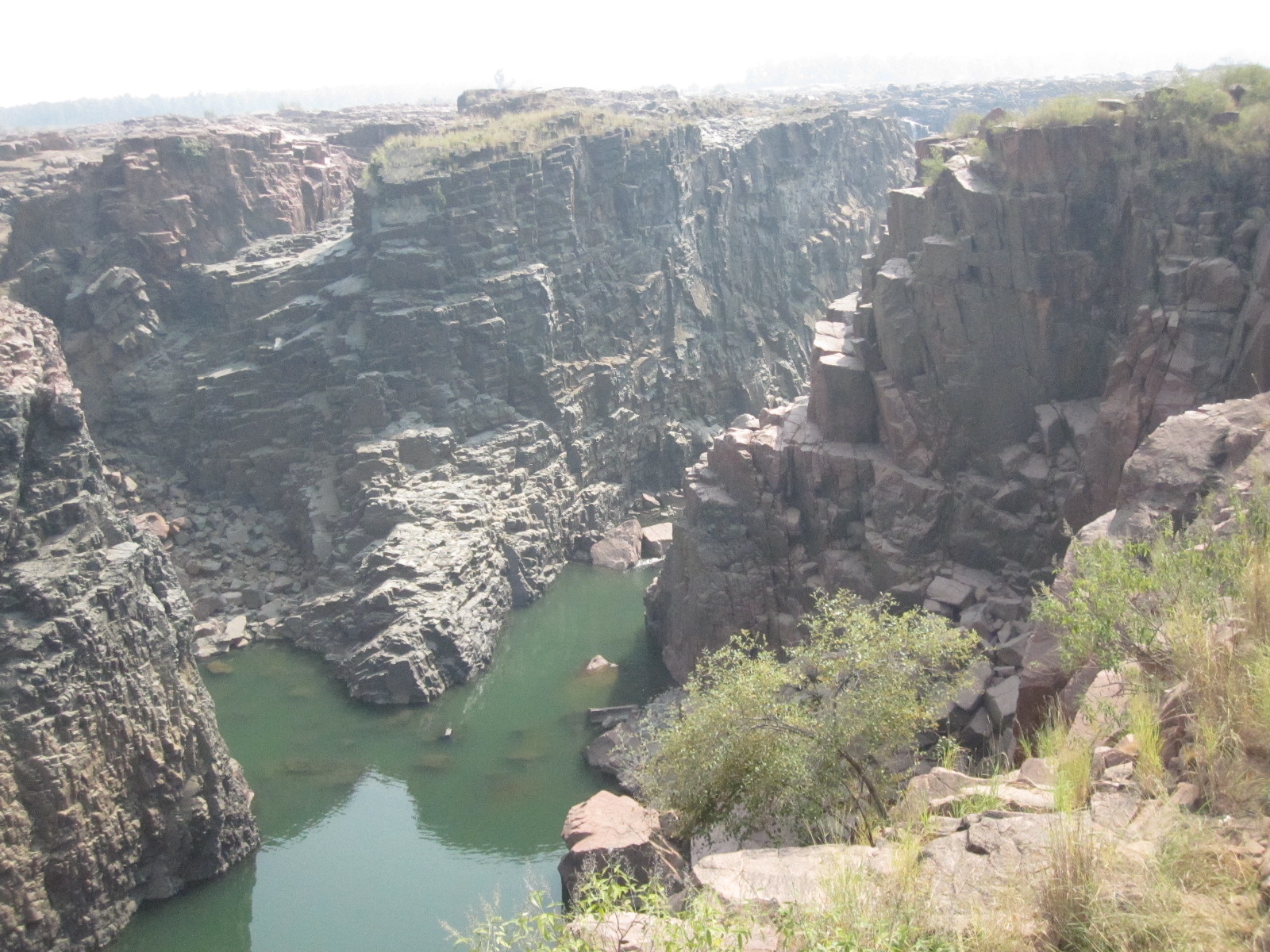
The following day we rode to Raneh Falls in an open jeep.  The falls were a bit disappointing because much of the water had been diverted for irrigation, but the variety of rock (granite, jasper, basalt, quartz) contrasted with the green water of the lake created a picturesque spot. 


Langur monkey stares at us as we invade his jungle
 We also went on “safari” through the surrounding jungle where we saw peacocks (India’s national bird), Langur monkeys, antelopes, and spotted deer.  We had hoped to see crocodiles, but no luck there.  (Poor Frank still hasn’t recovered from the disappointment of not seeing crocodiles in the wild when we were in the Daintree Rainforest in Australia 6 years ago.  Looks like India will be not much better.)

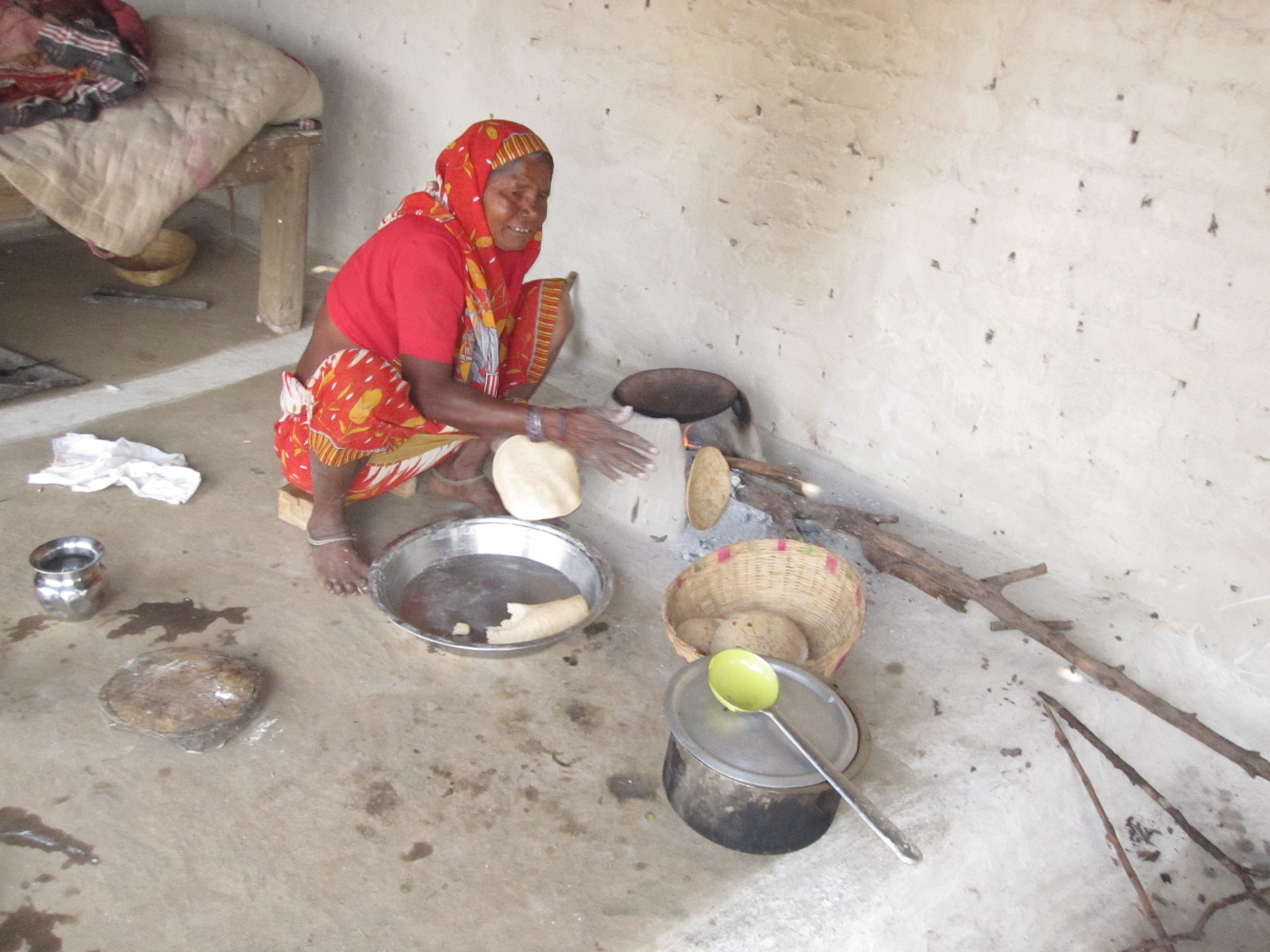
Woman cooking a meal for her family in her primitve kitchen

What made the jaunt in the jeep most fun was having an unobstructed view of the villages that we passed through as we traveled to and from the falls.  We even stopped at one village home where a young woman churned goat’s milk in a demo of how to make butter, and then showed us her primitive outside kitchen, where she sat on the dirt floor and tended to a few pots that were brewing unknown food-stuff over a small open fire.  As we drove by, we got a terrific view of village life and lots of friendly waves and “hallos” from the locals.  By the way, you have to picture Frank standing up in the back of this jeep holding onto the roll bar, taking pictures and waving to the locals – it was like “return of the Maharajah!”
Uddam (left), Anne, and Jyote Das
Back in town, we decided to brave the touts and go for a walk.  Anne found some great souvenirs and Frank did some fun dickering with the street vendors.  Then, we ran into a young Hindu couple we had met yesterday at the temples.  Jyote and Uddam Das were very sweet young newlyweds – we think they are enamored of all things American and that’s why they really took a liking to us.  They wanted to buy us something to eat from one of the vendors along the dusty main drag, but Anne got nauseous just looking at the street food that they wanted to treat us to, and the cooking methods and utensils used.  We finally settled on a fresh juice stand.  Anne still had visions of a full night on the crapper dancing through her head, but we just couldn’t insult these nice people who only wanted to be friendly.  Luckily, we had no repercussions from the juice.  One odd thing was when Jyote and Uddam showed us all the jewelry they were wearing and told us the price they paid for each piece.  Anne had read that rather than deposit money in the bank, Indians will invest in gold jewelry, and wear it.  These kids were obviously quite proud of their gold acquisitions, so I guess this whole gold discussion was like taking a look at their stock portfolio!
We exchanged email addresses with our new friends, and for some reason, they give us a ton of contact information: 3 or 4 email addresses each, along with an assortment of cell phone numbers.  They seemed stunned when we tell them we don’t have a cell phone.
Chowing down on the roof terrace of the
 Mediteranneo Restaurant
A word about the food:  For those of you who may not know, stomach ailments are quite common for travelers in India, and we have to be very careful.  We obviously cannot drink the water, so we use bottled water for almost everything including brushing our teeth.  We also clean all of our silverware using beer, hot tea, or some strong booze from the flask of 100 proof whiskey that Frank brought along just for this purpose.  We are also eating mostly vegetarian food with some chicken (any other meat is iffy).  Frank loves the spicy hot foods and soups, and the fabulous unleavened breads, but it could create some embarrassing situations if you consume too much of their spices.  Anne is a big fan of paneer, a solid cottage cheese that is cut into cubical chunks (looks like tofu) and served with various vegetable sauces.
Raneh Falls in the Indian wilderness
For the most part, we have been eating at our hotels, which works out well – their food is pretty safe and convenient too.  In Varanasi, we ate dinner at a Lonely Planet recommended restaurant called The Brown Bread restaurant.  What an experience.  The restaurant was in the Old City, so it looked like a real dump on the outside – a typical Varanasi hovel-type place carved from stone with a narrow stairway to the 2nd floor.  The decorum of the restaurant was raised up stone cubicles where the patrons sat on a thin mattress at a low table using cushions to support their backs – sort of “sultan” style.  The ambience was further enhanced by an old man with flowing white hair playing the sitar alongside a bongo player.  Anne thought it was romantic (like eating in a Kasbah), and she could easily picture the expats of the 60’s hanging out in a place like this.  Frank thought the seating horribly uncomfortable and impractical, and was very leery of the overall food sanitation.  Surprisingly, the food was fabulous, and nobody had repercussions.

Young Indian boys entertain us at the Jain Temples
Another challenge here in India has to do with the plumbing in the bathrooms.  Hotel Harmony is a good example.  Nobody seems to know how to make a decent bathroom in this country! This bathtub shower kluge of spigots and water delivery devices looked like an overthought control panel on some kind of primitive Flash Gordon space craft. It had five knobs with which to play around with to somehow make the water flow, two faucets, and one showerhead.  In order to take a shower, you had to turn on the two lower knobs, one for hot and one for cold, which caused water to flow out of the two faucets.  Once you had what seemed like a good balance between hot and cold water, you moved on to the upper dials which activated the showerhead, adjusting these dials between hot and cold also.  By the way, this whole operation is conducted as you stand perched on the ledge on the side of the bathtub (to avoid being either scalded or frozen when the water comes on suddenly).  And of course, after you finish your shower, you have to reverse the whole process.  Additionally, there are all sorts of unexplained water valves all around the bathroom that don’t seem to do anything.  Also, there are lots of spigots protruding from the walls at ankle height, and they are easy to trip on if you are not watching your step. Thank God, Frank the engineer sorted this all out – otherwise Anne would have been taking a sponge bath at the sink!

Standard road hazards of India